
Neck Pain Physical Therapy in Tampa: How Lifters and Desk-to-Gym Athletes Fix a Stiff, Sore Neck
It starts as a tight spot at the base of your neck after a long day at the desk, gets sharper on a heavy set of deadlifts or shrugs, and by the next morning checking your blind spot on the Howard Frankland takes your whole upper body. Here’s a doctor-led guide for Tampa & St. Petersburg lifters, hybrid athletes and runners who work desk jobs: what’s really behind neck pain, the red flags, how long it takes, the training swaps that keep you lifting, and the strength plan that fixes it.

Neck Pain Physical Therapy in Tampa: When Your Neck Won’t Let You Train (or Work)
Most people searching for neck pain physical therapy in Tampa describe the same kind of week. A tight spot at the base of the neck builds through a long day at a laptop. A heavy set of deadlifts, shrugs or farmer’s carries that evening makes it sharper. The next morning, turning to check a blind spot on the commute is suddenly a whole-body movement, and by mid-afternoon a headache has crept in behind one eye. They’ve tried a massage gun, a new pillow, a standing desk and a few days off lifting. It eases, then comes back the first time work and training both get busy.
It’s one of the most common problems there is. The Global Burden of Disease study estimated that 203 million people worldwide had neck pain in 2020, with women affected more often than men (GBD 2021 Neck Pain Collaborators, Lancet Rheumatol, 2024). In the US, low back and neck pain together had the highest health care spending of 154 conditions studied, an estimated $134.5 billion in 2016 (Dieleman et al., JAMA, 2020).
It also tends to come back. A major international task force concluded that between half and three quarters of people with neck pain will report it again one to five years later (Carroll et al., Spine, 2008). If you’re a lifter, hybrid athlete or runner in your 30s or 40s with a desk job, that isn’t a reason to stop training. It’s a reason to deal with it properly, and to build a neck that can handle your whole week, not just your workouts.
This guide covers what’s actually going on, how to tell neck pain from shoulder pain and a pinched nerve, the red flags that need a physician, how long it realistically takes, how to keep lifting while it settles, and how our performance physical therapy gets lifters and desk-to-gym athletes back to full training.
The Short Version
- Most neck pain is a load problem, not damage. Disc bulges show up on the MRIs of most adults with no neck pain at all, even people in their 20s.
- Posture isn’t the villain it’s made out to be. Studies haven’t found a clear link between how people sit and whether their neck hurts. Moving often matters more than sitting perfectly.
- You can usually keep training. Swap the lifts that flare it, such as heavy shrugs, cranked-neck deadlifts and kipping, and judge it by how your neck feels the next morning.
- Strength training has some of the best evidence. In a randomized trial of office workers with chronic neck muscle pain, ten weeks of targeted strength work cut their worst pain by about 79%.
- Know the red flags. A sudden, severe headache during a lift, dizziness, double vision, trouble speaking or swallowing, or clumsy hands need a physician, and some need 911.
What’s Really Behind Neck Pain (and Why It’s Rarely Damage)
Your neck is seven small vertebrae stacked on top of your rib cage, cushioned by discs, linked by small facet joints on each side, and wrapped in layers of muscle: the deep neck flexors at the front, the small suboccipital muscles at the base of your skull, and the upper trapezius and levator scapulae that run from your neck to your shoulder blade. A nerve root leaves the spine at each level and runs down into the arm. All of it holds up a head that weighs roughly 10 to 12 pounds, turns it 70 to 80 degrees each way, and transfers load every time you deadlift, carry, press or pull.
Most neck pain in active adults is what clinicians call mechanical or nonspecific neck pain: joints and muscles that have become sensitive because the total load on them, from training, work, sleep and stress, has outpaced what they’re prepared for. It can hurt a lot, but it’s rarely a sign of damage. That matters, because the scan findings people worry about are extremely common in necks that don’t hurt at all. In an MRI study of 1,211 adults with no neck symptoms, 87.6% had bulging discs, including 73.3% of the men and 78.0% of the women in their 20s (Nakashima et al., Spine, 2015).
The physical therapy clinical practice guideline for neck pain, published by the Orthopaedic Section of the American Physical Therapy Association, sorts neck pain into four broad patterns that shape the plan: neck pain with mobility deficits (the classic stiff, sore neck), neck pain with headaches, neck pain with radiating arm pain (an irritated nerve root), and neck pain with movement coordination problems, which includes whiplash after a collision (Blanpied et al., J Orthop Sports Phys Ther, 2017).
For lifters, the most common question is simpler: is this really my neck, or is it my shoulder, or a nerve?
| At a glance | Neck pain | Shoulder pain | Pinched nerve in the neck |
|---|---|---|---|
| Where it hurts | Back and side of the neck, base of the skull, top of the shoulder, sometimes between the shoulder blades | The front, side or top of the shoulder itself, sometimes into the upper arm, rarely past the elbow | From the neck or shoulder blade down the arm, often past the elbow into the forearm or hand |
| What sets it off | Turning, tilting, or looking up or down; long stretches in one position | Lifting the arm, pressing, reaching overhead or behind your back | Certain neck positions, especially looking up or tilting toward the sore side; resting your hand on your head may ease it |
| How it feels | Stiff and achy, sometimes sharp on turning; can come with headaches | A pinch or ache in the shoulder, sometimes catching or weakness at certain angles | Burning, electric or deep aching arm pain, with pins and needles, numbness or weakness |
| Common gym triggers | Heavy shrugs and carries, deadlifts with the head cranked up, kipping, a long desk day right before training | Bench, dips, overhead pressing, kipping and wide-grip work | Heavy overhead work, looking up under load, long periods with the head forward or tilted |
| What usually fixes it | Movement, neck and upper-back strength, load changes, hands-on care to open a window | Shoulder and shoulder-blade strength and load changes; see our shoulder pain guide for lifters | Calming the nerve root, positions that ease it, gradual loading; sometimes a physician referral |
They overlap often. A stiff neck and a cranky shoulder frequently travel together in pressing-heavy lifters, and an irritated nerve root in the neck can send pain to the shoulder blade, the shoulder or even the elbow. If you’re not sure which one you’re dealing with, the self-check below and an assessment will sort it out.
Neck and Shoulder Pain? A Neck Pain Map
Put a hand where it hurts and think about what sets it off. Neck pain in active adults usually falls into a handful of patterns. They overlap, and none of them is a diagnosis on its own, but they tell us where to look first.
One Side of the Neck, Stiff to Turn
Usually: mechanical neck pain (a stiff, sore neck)
You woke up with it, or it caught on a lift, and now turning your head one way hurts and feels blocked. It’s worse first thing and after sitting still, and better once you’re moving. An acute stiff neck often settles within days to a couple of weeks if you keep it moving.
Top of the Shoulder and Base of the Neck
Usually: an overloaded, sensitive upper trapezius or levator scapulae
A tender, ropey ache along the top of the shoulder and up into the neck, with knots you can press on. It builds through long desk days and after heavy shrugs, carries and sled pulls. This is where dry needling and strength work earn their keep.
Base of the Skull, One-Sided Headache
Possibly: a cervicogenic (neck-related) headache
A headache that starts at the back of the neck and spreads over the head toward the forehead or behind the eye, usually on one side. It’s often set off by sustained postures or certain neck movements, and turning your head is stiff on the same side.
Between the Shoulder Blades
Possibly: the upper back, or pain referred from the neck
A deep ache along the inner edge of the shoulder blade. It can come from the joints of the upper back and ribs after heavy rows or pull-ups, but the lower neck refers pain here too, so we always check both.
Down the Arm, Past the Elbow, With Tingling
Usually: an irritated nerve root (cervical radiculopathy)
Arm pain that’s often worse than the neck pain, with pins and needles or numbness in part of the hand, and sometimes a weaker grip. Looking up or tilting toward the sore side makes it worse; resting your hand on top of your head often eases it.
Neck Pain With Dizziness, Double Vision or a Sudden Severe Headache
Possibly: a problem with a blood vessel
Neck pain or a headache that comes on with dizziness, double vision, slurred speech, trouble swallowing, facial numbness or an unsteady walk, or a sudden “worst-ever” headache during a heavy lift. Call 911. That’s not a rehab problem.
A stiff, sore neck and an overloaded upper trap, often with a headache on bad days, are the patterns most of this guide is about. The nerve pattern gets its own advice where it differs.
Why Lifters, Hybrid Athletes and Desk-to-Gym Professionals Get Neck Pain
Neck pain rarely comes from a single cause. In the active adults we see, it’s usually the total load across the week, in the gym and out of it, outpacing what the neck and upper back are prepared for. Most cases come from some combination of these:
- A spike in upper-trap work. A new program with heavy shrugs, rack pulls and farmer’s carries, or a HYROX block. A HYROX race includes a 50 m sled pull and a 200 m farmer’s carry, and training for it often means doing both, heavy, every week.
- Head position under load. Cranking your head up to watch yourself in the mirror on a heavy deadlift, jutting your chin to clear the bar on pull-ups, driving the back of your head into the bench, or shoving your head forward “through the window” on an overhead press.
- Loading through the head. Handstand push-ups, headstands and high-volume kipping all put load or speed through the neck that most people haven’t trained for.
- Long, static workdays. Eight or more hours at a laptop, often with a meeting-packed day and no breaks, then straight to a 6 p.m. class. It’s not one “bad” posture so much as a lack of movement plus fatigue, right before you ask your neck to work hard.
- Sleep and stress. Short sleep and a deadline-heavy week turn up the sensitivity of a neck that’s already overloaded. In the general population, psychological health and coping were among the strongest predictors of how neck pain played out (Carroll et al., 2008).
- Long rides and one-sided habits. Hours on a road bike with your head up and neck extended, breathing to one side in the pool, or carrying a heavy bag on the same shoulder every day.
- A neck that’s never trained directly. Many lifters hammer the traps but never train the muscles that actually hold the head, so the neck is the weak link when the load climbs.
Lifters: the “neck tweak” on a heavy pull
It usually happens on a heavy deadlift lockout, a shrug or the last rep of a set: a sharp catch on one side of the neck, and within an hour you can’t turn your head that way. It’s scary, and it often feels like something has slipped. In most lifters it hasn’t. It’s a sensitized joint and a lot of protective muscle guarding, and it tends to settle quickly with gentle movement and a few days of modified training. What deserves a closer look is the pattern behind it: the neck tweak that keeps happening at the same point in every training block is telling you something about load, position or capacity.
Desk-to-gym athletes: it’s not (just) your posture
“Fix your posture” is the most common advice for neck pain, and the evidence for it is weaker than most people think. In 1,108 seventeen-year-olds photographed while sitting, four distinct neck posture types were found, and none of them made neck pain or headache more likely (Richards et al., Phys Ther, 2016). In 150 young adults texting on their phones, “text neck” posture wasn’t associated with neck pain either (Damasceno et al., Eur Spine J, 2018). Those studies were in younger people, so they don’t settle the question for a 40-year-old with a 50-hour work week, but they do challenge the idea that posture alone is the cause.
What we see clinically is that a sensitive neck doesn’t like any single position for hours, whether it’s “good” or “bad.” The best posture is your next one. And the most useful thing a desk-bound athlete can do for their neck isn’t a new chair. It’s making the neck and upper back stronger, which is exactly what the research on office workers supports, as you’ll see below.

Red Flags: When Neck Pain Needs a Physician First
Most neck pain in lifters, runners and desk-based athletes is something a physical therapist can assess and treat directly, and in Florida you can start without a referral. A few patterns need a physician first, and some need emergency care right away.
Call 911 if:
- You get a sudden, severe headache, the worst of your life, during or right after a heavy lift or strain. A “thunderclap” headache can signal bleeding around the brain and needs emergency assessment, even if it starts to ease.
- Neck pain or a headache comes with dizziness or vertigo, double vision or vision loss, slurred speech, trouble swallowing, facial numbness or drooping, weakness or numbness on one side, or an unsteady walk. These can be signs of a stroke or of a tear in one of the arteries in the neck, which can follow a sudden movement or minor trauma.
- Neck, jaw, shoulder or arm pain comes with chest pressure, shortness of breath, a cold sweat or nausea, especially with exertion. These can be heart attack warning signs.
- You’ve had a car crash, a fall or a collision and now have neck pain with numbness, tingling or weakness, or pain right over the bony middle of your neck. Keep still and get emergency care.
See a physician promptly if:
- Your hands feel clumsy, you’re dropping things or struggling with buttons or handwriting, both hands are numb or tingling, your walking or balance has changed, or you notice any change in bladder or bowel control. These can be signs of pressure on the spinal cord, and bladder or bowel changes need same-day care.
- Your arm or grip is getting steadily weaker, rather than just painful.
- You have a stiff neck with a fever, a severe headache, sensitivity to light or a rash. That needs urgent medical care the same day, usually in an emergency room.
- Pain is constant, wakes you at night or keeps getting worse regardless of what you do, or comes with unexplained weight loss, a history of cancer or feeling generally unwell.
None of these automatically means something serious. They mean the plan starts with the right clinician. If you’re not sure whether any of them apply, a physical therapy evaluation screens for all of them in the first session and points you to the right physician when you need one.
Neck, Shoulder or Nerve? A Five-Minute Self-Check
If none of the red flags apply, these checks help you see which pattern you’re dealing with and give you a baseline to track. They aren’t a diagnosis and they don’t replace an assessment. Move slowly, and stop any test that causes sharp pain, dizziness, or tingling spreading down the arm.
- Look over each shoulder. Sit tall and turn your head slowly as far as is comfortable each way. Most people get their chin close to in line with their shoulder. Note which side is stiffer, and whether you feel it in the neck or down into the arm.
- Trace where it goes. Pain that stays in the neck and top of the shoulder fits a stiff, sore neck. Pain that runs past the elbow, especially with pins and needles or numbness in part of the hand, points to a nerve root.
- Move the shoulder, then the neck. Raise your arm overhead and reach behind your back with your neck still. Then keep your arm still and move your neck. If the arm movements reproduce your pain and the neck movements don’t, the shoulder is the more likely source. If it’s the other way round, it’s more likely the neck.
- Rest your hand on your head. If you have arm pain, put the hand of the sore side on top of your head and wait a minute. If the arm pain eases, that’s a classic sign that a nerve root in the neck is involved.
- Try a chin-tuck head lift. Lie on your back, gently tuck your chin as if making a double chin, then lift your head about an inch off the floor and hold it. Stop when your chin pokes forward or your head drops. In healthy adults, the average hold was about 39 seconds for men and 29 for women, with a lot of variation between people (Domenech et al., PM R, 2011). Skip this one if it brings on pain or dizziness.
Numbers worth tracking
Check your rotation each way and your chin-tuck hold at the same time each week, and keep a rough count of headache days. Clinicians also use a short questionnaire called the Neck Disability Index, ten questions about how neck pain affects your daily life, where a lower score is better. A recovering neck should be trending toward easier rotation, a longer hold, fewer headache days and a lower score. That trend tells you far more than “does it still hurt?”, and it’s the kind of measure we track in a movement assessment.
Not sure which one you’ve got? A one-on-one assessment answers that in the first session: pinpointing the source, ruling out the red flags, and giving you a plan that keeps you training where possible. See how our performance physical therapy works, or book a free discovery call to talk it through first.
How Long Does Neck Pain Last?
It depends on the type, and it’s often longer than people expect. The research gives a realistic picture:
- New neck pain improves fastest early on, then often stalls. In a meta-analysis of people with new neck pain who had little or no treatment, average pain fell from 64 to 35 out of 100 over the first six and a half weeks, but was still around 42 out of 100 at one year, and disability stopped improving after the first six weeks (Hush et al., Arch Phys Med Rehabil, 2011).
- It often comes back. Between half and three quarters of people with neck pain report it again one to five years later (Carroll et al., 2008).
- A pinched nerve usually settles without surgery, but takes longer. In a population study of 561 people with cervical radiculopathy in Rochester, Minnesota, 90% had no symptoms or only mild limitations at follow-up, a median of almost five years later. About a third had a recurrence along the way, and 26% had surgery (Radhakrishnan et al., Brain, 1994).
- Strength programs work in weeks and months, not days. The trials that improved chronic neck pain with strength training ran from 10 weeks to 12 months (Andersen et al., 2008; Ylinen et al., 2003).
In practice, a stiff neck you woke up with or tweaked on a lift often settles within days to a couple of weeks. A neck that has been flaring on and off for months usually needs 8 to 12 weeks of progressive strength work to really change, and arm pain from a nerve root often takes several weeks to a few months. The quickest, most lasting improvement comes when the plan deals with why it keeps flaring, not just the current episode.
Do you need an MRI or X-ray?
Usually not at first. Disc bulges and wear are so common in pain-free necks, in 87.6% of the adults in the Nakashima study, that a scan often shows changes that have nothing to do with your pain, and reading “disc bulge” on a report can make people more afraid to move (Nakashima et al., 2015). Imaging is worth it after significant trauma, when any of the red flags above are present, with progressive weakness or signs of pressure on the spinal cord, or when arm pain isn’t improving after several weeks and the result would change the plan, such as when an injection or surgery is being considered. Otherwise, how your neck responds to movement and load tells us far more than how it looks.
Can You Keep Lifting With Neck Pain? Usually, With the Right Swaps
Neck pain responds to movement and load, so stopping everything isn’t the answer, and neither is grinding through the same program. The aim is to keep as much of your training as your neck tolerates, change the lifts that flare it, and judge it by the next-day response rather than the pain in the moment. It’s the same idea as the traffic-light model in our guide to training through pain as a HYROX athlete: pain is information about load, not an automatic stop sign.
The Simple Rules
- During training: mild neck discomfort up to about 3 out of 10 that doesn’t climb set to set is acceptable. Sharp pain, pain that keeps rising, or any tingling, numbness or pain spreading further down the arm means that exercise is done for the day.
- The next morning: re-check how far you can turn your head each way and how your neck feels getting out of bed. If it’s no worse than your usual baseline, the load was fine. If it’s worse, scale the next session back before progressing again.
- One change at a time: add load, volume or a lift that used to flare it, never more than one in the same week.
Training swaps that usually work
This is where most lifters lose strength they don’t need to. Treat the table below as a starting point, not a prescription: keep what’s quiet, change what isn’t.
| Movement | What usually provokes it | Try instead, for now |
|---|---|---|
| Deadlifts and pulls | Cranking the head up to watch the mirror, heavy singles and grinding lockouts, rack pulls finished with a big shrug | Eyes on a spot on the floor a few feet ahead so your neck stays in line with your back; a trap bar; working sets at RPE 7 to 8 instead of top singles for a couple of weeks |
| Shrugs, carries and sled pulls | Heavy shrugs with the chin pushed forward, long heavy farmer’s carries, HYROX-style rope sled pulls | Lighter, shorter carries with a tall posture; controlled shrugs with a pause at the top; rows and lateral raises; build carry distance back up week by week |
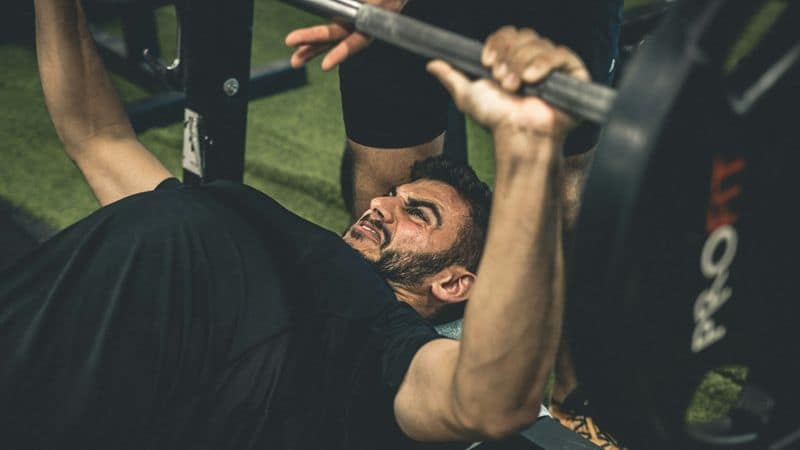
| Bench press | Driving the back of your head into the bench, straining the neck as you brace | Head resting relaxed on the bench, drive through your upper back and feet; a slightly lighter load or dumbbell and floor presses if it still bothers you |
| Overhead press and jerks | Shoving the head forward fast to get “through the window,” behind-the-neck presses, heavy push presses and jerks | Landmine presses or half-kneeling single-arm dumbbell presses; move the head back smoothly rather than snapping it; drop behind-the-neck work for now |
| Pull-ups and kipping | Reaching the chin over the bar, kipping pull-ups and toes-to-bar for high reps | Strict pull-ups pulling the chest to the bar, lat pulldowns, ring rows; bring kipping back last |
| Handstand push-ups and burpees | Head contact on the floor, headstands, whipping the head on fast burpees | Pike push-ups on a box with no head contact or strict dumbbell presses; step-back burpees at a steady pace |
| Running and cycling | Tense, hunched shoulders late in a long run; hours on the bike in a low position with the head up | Easy runs usually carry on with relaxed shoulders and eyes on the horizon; shorter rides, a higher handlebar position for a while, and regular changes of hand and head position |
Squats, lunges, sled pushes, rowing, the bike and lower-body work usually carry on with little change. For back squats, set the bar on the meaty part of your upper traps rather than the bony bump at the base of your neck, and keep your gaze level or slightly down. For most lifters, the big lifts stay in the program; they just change shape for a while.
Why your workday matters as much as your workout
In desk-to-gym athletes, neck pain often isn’t caused by any single lift. It’s eight hours in one position, a deadline, five hours of sleep, and then a heavy pulling session at 6 p.m. We’re not saying the pain is in your head. We’re saying stress and short sleep turn up the volume on a neck that’s already overloaded, so a good plan accounts for the workday as well as the workout: short movement breaks every 30 to 45 minutes, a few minutes of neck and upper-back exercises at the desk, and training scheduled with your week in mind.
Can you run with neck pain?
Usually, yes. Easy running is generally well tolerated, and the movement often helps. Keep your shoulders relaxed and your arms swinging, look at the horizon rather than down at your watch every few strides, and save hard, tense efforts until things have settled. Bayshore Boulevard and the St. Pete waterfront are ideal for it: flat, and easy to cut short. For more on running through the rest of your body, see our guide to physical therapy for runners in Tampa.

What a Neck Pain Physical Therapy Assessment Looks For
A scan, if you have one, shows what your neck looks like. It doesn’t show how much load it can take today, why it keeps flaring, or when you’re ready for heavy pulls, kipping or a race again. Here’s what a doctor-led movement assessment for neck pain covers at Forward Physio.
Pinpointing the Source
Neck, shoulder, upper back or nerve root? A neurological screen of strength, sensation and reflexes in both arms, tests that load the nerve roots and the nerves of the arm, a shoulder screen and the red-flag checks, so the plan starts from the right diagnosis.
Mobility, Joint by Joint
Rotation, tilting and looking up and down, measured side to side, plus how each level of your neck and upper back moves. Stiffness in the upper back often shows up as neck pain, so we look at both.
Strength and Endurance
Deep neck flexor endurance, neck strength in every direction, and the upper back and shoulder-blade muscles that support it: upper, middle and lower traps, rhomboids and grip. Measured, so we can re-test it as you progress.
Your Training and Work Week
Every source of neck load across the week: your lifts and head position under the bar, carries, sled pulls and kipping volume, desk hours and setup, commute, sleep and stress. Bring video of your deadlift or your press if you have it. Neck pain is often as much a scheduling problem as a tissue problem.
Every one of those is re-tested as you progress. That’s how we decide when you’re ready to pull heavy, kip, carry and race again: on the numbers and the next-day response, not because a set number of weeks has passed.

How We Approach Neck Pain Physical Therapy at Forward Physio
The plan is simple to describe: calm the neck down without shutting your training down, use hands-on work to open a window, build neck and upper-back strength, retrain the deep neck muscles where headaches or a nerve root are involved, then return to full training on criteria. It follows the active, evidence-based approach in the clinical practice guideline, built into a doctor-led, one-on-one plan around how you train and work.
Calm It Down Without Shutting You Down
We start by explaining what’s going on, because knowing that a disc bulge on a report is common and that your neck isn’t fragile changes how people move. Then we pull back the lifts and positions that flare it, using the swaps above, and keep the rest. Gentle, frequent movement through the range your neck tolerates beats keeping it still. Soft collars and avoiding movement usually make a stiff neck stiffer.
Use Hands-On Work and Dry Needling to Open the Window
Skilled manual therapy to the neck and upper back can ease pain and restore movement in the short term. A systematic review found that thoracic (upper back) manipulation improved pain, range of motion and function in people with acute and subacute mechanical neck pain, although the reviewers rated the body of evidence as weak (Cross et al., J Orthop Sports Phys Ther, 2011). Dry needling of sensitive trigger points in the upper trap and levator scapulae helps too: a review of 20 randomized trials found it reduced neck and shoulder trigger-point pain compared with sham or no treatment, from immediately afterward through the following weeks (Liu et al., Arch Phys Med Rehabil, 2015), and in a trial of 130 people with chronic neck pain, dry needling plus stretching beat stretching alone for up to six months (Cerezo-Téllez et al., Pain, 2016). We use both as part of a broader pain management plan that buys a window for the strength work, not as the fix on their own.
Build Neck and Upper-Back Strength
This is the backbone, and it’s good news for anyone who already lifts. In a randomized trial of 48 women with chronic neck muscle pain from computer-heavy jobs, ten weeks of targeted strength training for the painful muscles cut their worst pain by about 79%, while general fitness training on a bike gave only a small, temporary drop (Andersen et al., Arthritis Rheum, 2008). In 180 female office workers with chronic neck pain, a year of neck strength or endurance training reduced pain and disability compared with a control group, with neck flexion strength up 110% in the strength group, and stretching and aerobic exercise alone proved much less effective (Ylinen et al., JAMA, 2003). The dose doesn’t have to be big to start: in 198 adults working at least 30 hours a week with frequent neck and shoulder pain, as little as two minutes a day of progressive resistance training with elastic tubing, five days a week, reduced pain over ten weeks (Andersen et al., Pain, 2011). We build it like any other program, with shrugs, rows, lateral raises, reverse flys and neck isometrics in every direction, progressed every week. That’s capacity-based strength training applied to the neck.
Retrain the Deep Neck Muscles, Especially for Headaches and Nerve Pain
For neck-related headaches, low-load training of the deep neck flexors pays off. In a randomized trial of 200 people with cervicogenic headache, both manual therapy and a specific exercise program reduced headache frequency and intensity, the effects were still there a year later; combining the two wasn’t significantly better, although about 10% more people gained relief (Jull et al., Spine, 2002). For arm pain from a nerve root, we use positions and movements that ease the nerve, gentle nerve mobility work and gradual loading. In a trial of 86 people with cervical radiculopathy, adding mechanical traction to exercise led to lower disability at six and twelve months than exercise alone (Fritz et al., J Orthop Sports Phys Ther, 2014), so traction is one more tool we can bring in when the nerve is the main problem.
Fix What Overloaded It, Then Return on Criteria
We map the load across your week and change what tipped it over: the new pulling block, the head position on your deadlift, the HYROX carry and sled-pull volume, the 10-hour workdays with no breaks, the travel week with no sleep. Then heavy pulls, kipping, handstand push-ups and race-day loads come back in planned steps once strength, range and the next-morning check say you’re ready. That’s a structured return to sport, not “try it and see.”
What about chiropractic adjustments, massage, collars and injections?
Spinal manipulation, whether from a physical therapist or a chiropractor, can give real short-term relief. A Cochrane review of 51 trials found that multiple sessions of neck manipulation and gentler mobilization produced similar results for pain and function, found support for upper-back manipulation, and noted a small risk of rare but serious side effects with neck manipulation (Gross et al., Cochrane Database Syst Rev, 2015). What it doesn’t do on its own is make your neck stronger or change why it keeps flaring, which is why weekly adjustments or massages that help for a day or two rarely end the cycle. Massage guns are fine for feeling better; they don’t build capacity. Soft collars are for injuries a physician has told you to protect, not for an everyday stiff neck. If arm pain from a nerve root isn’t improving after a fair trial of good rehab, or weakness is getting worse, an injection or a surgical opinion is a reasonable conversation with a spine physician, and we’re happy to coordinate that.
One-on-One, Doctor-Led Care vs. the Insurance-Driven Neck Visit
Neck pain is a textbook example of why the care model matters. The insurance-driven version looks the same in most places: a hot pack, some electrical stimulation or ultrasound, a few chin tucks and shoulder rolls, maybe a few minutes of massage, and a printout, with one clinician splitting time between three or four people. None of that builds a stronger neck, or answers the questions you actually have: can I still deadlift on Monday, why does this flare every time work gets busy, and how do I stop the headaches?
Answering those takes time: measuring your neck’s range and strength, finding the source, progressing the load every week, coaching your head position on the lifts that matter, and fitting the plan around your training, your workday and your next race. At Forward Physio every session is 45 to 60 minutes, one-on-one, with a doctor of physical therapy: no techs, no shared time, and no passive modalities. Both of our doctors lift, run and train for HYROX themselves, and both are dry needling and barbell rehab certified, so the conversation starts from how you train rather than from a generic protocol.
You don’t need a physician referral to start physical therapy in Florida. We’re an out-of-network provider: we don’t bill insurance directly, but we provide detailed superbills you can submit for possible out-of-network reimbursement, and we accept HSA and FSA cards. Our FAQ covers the details, and a free discovery call is the easiest way to find out whether we’re the right fit.
Most sore necks aren’t fragile. They’re under-trained, overworked and under-slept, and all three are fixable.
A Return-to-Lifting and Training Progression for Neck Pain
This is the framework we adapt for each athlete. How fast you move through it varies a lot, depending on the type of neck pain, how long it has been going on and what your training asks of it; the rules for moving between phases (the simple rules above) don’t.
- Phase 1: Settle (usually days to two weeks). The lifts that flare it are modified or paused. Gentle range-of-motion work several times a day, chin-tuck holds and light neck isometrics. Lower-body training, conditioning, easy running and most upper-body work carry on.
- Phase 2: Build strength (roughly weeks 1 to 8, and kept for good). Neck isometrics in every direction progressing to resistance bands, then shrugs, rows, lateral raises, reverse flys and carries two to three times a week, with load progressing as the next-morning check allows.
- Phase 3: Reload the big lifts (often from around weeks 3 to 6). Deadlifts, overhead presses, heavier carries and sled pulls back to working weights with a neutral head position, built up in volume before load.
- Phase 4: Full training and competition. Heavy singles, kipping, handstand push-ups, race-day carries and sled pulls, built back up week by week, with neck and upper-back strength work kept in twice a week.
Checkpoints before heavy lifting and before competing
- Before heavy pulls and pressing: rotation close to equal and comfortable both ways, no arm symptoms, a chin-tuck hold close to normal, and two weeks of strength work with no next-morning flares.
- Before competition, a HYROX or high-volume kipping: race-day carries, sled pulls and kipping volume done in training without a flare, normal arm and grip strength compared with the other side if a nerve was involved, and a full week of normal training and work with no next-morning setbacks.
How long does that take? For a recent stiff neck or a lifting tweak, a few days to a couple of weeks to feel better and three to six weeks to be fully back is common. Long-standing neck pain and nerve-root pain often take longer. If your neck isn’t steadily improving after six to eight weeks of well-dosed rehab, it’s worth a closer look, including imaging or a physician opinion if the result would change the plan. Readiness for your meet, your HYROX or your next block is decided by the criteria, not the calendar.

Training and Working in Tampa Bay: Where Necks Get Tested
A few things about life and training here make neck pain worth getting on top of early, especially heading into winter.
- Desk to barbell is the local default. A day at a laptop in Westshore, on Water Street, in downtown Tampa or downtown St. Pete, then a 6 p.m. class or barbell session, gives a stiff neck very little time to warm up. Five minutes of easy neck and upper-back movement before your first heavy set makes a real difference.
- Bridge commutes. A daily drive across the Howard Frankland, the Gandy or the Courtney Campbell adds time sitting still, and a stiff neck turns every blind-spot check on I-275 into a reminder.
- HYROX has arrived. HYROX held its first-ever Tampa race at the Tampa Convention Center from October 22 to 25, 2026, with organizers expecting around 18,700 athletes (Hoodline). For a lot of local athletes, that race is now the benchmark, and the next block, with more farmer’s carries, sled pulls and wall balls, is already starting. The CrossFit Open usually starts in late February, so kipping and handstand push-up volume climbs through the winter too.
- Gasparilla season. The Publix Gasparilla Distance Classic Race Weekend returns February 20–21, 2027, for its 50th running (Gasparilla Distance Classic). Long runs on Bayshore are when shoulders creep up toward the ears, especially on the last few miles.
- Long rides on flat roads. The Courtney Campbell Trail, the Pinellas Trail and the roads out to Fort De Soto make it easy to ride for hours without changing position. In one study in the task force review, regular cycling predicted a poorer outcome for neck pain (Carroll et al., 2008), so cyclists and triathletes are worth a bike-fit conversation if their neck keeps complaining.
- Holiday travel. Thanksgiving is November 26, and the weeks after it bring flights out of TPA, sleeping upright on planes, laptops on the couch and missed training. It’s one of the most common times for a quiet neck to flare.
None of that means training less. It means planning neck and upper-back load the way you’d plan your deadlift program or your weekly mileage.
Keeping Neck Pain From Coming Back
Necks that have been sore before tend to complain again when work and training both ramp up. We’ve written about why “injury prevention” is really risk reduction, but the evidence here is encouraging. In a review of prevention trials, exercise programs reduced the risk of a new episode of neck pain, while ergonomic programs didn’t (de Campos et al., J Physiother, 2018). The athletes who stay on track with healthy necks tend to share a few habits:
- They keep training their neck and upper back after the pain is gone. Two short sessions a week, year-round, of rows, shrugs, lateral raises, reverse flys and neck isometrics. The neck keeps the capacity you keep using.
- They move often during the workday. A short break every 30 to 45 minutes, some calls taken standing or walking, and a screen at roughly eye level beat sitting perfectly still in a perfect chair.
- They change one thing at a time. A new pulling block, a HYROX build and a busy quarter at work all starting in the same month is how a quiet neck becomes a sore one.
- They protect sleep and respect stress. When sleep drops and deadlines stack up, they trim training volume for a week rather than adding heavy singles.
- They get assessed before a big block. A proactive performance assessment six to eight weeks before a HYROX, a meet or a race catches strength and mobility gaps before your training finds them. That’s what our injury prevention work is built around.
If the pain sits in the shoulder itself rather than the neck, our guide to shoulder pain physical therapy for lifters covers that side, and elbow pain that might be coming from the neck is covered in our tennis elbow guide. For lower down the spine, read why your back is not fragile and why your deadlift might be causing back pain.
Lift, Work and Sleep Without Neck Pain — Book a Neck Pain Evaluation in Tampa
If your neck stiffens up after every long workday, flares on heavy pulls and carries, brings on headaches or sends pain down your arm, let’s build you a real plan. One-on-one time with a doctor of physical therapy, a clear answer on what’s actually going on, a screen for the red flags, and a criteria-based roadmap back to heavy lifting, racing and pain-free workdays. Serving lifters, HYROX and CrossFit athletes, runners and cyclists across Tampa, South Tampa, Westshore and St. Petersburg.
Book Your Neck Pain EvaluationNeck Pain Physical Therapy in Tampa: Frequently Asked Questions
Common questions we hear from lifters, HYROX and CrossFit athletes, runners and desk-based professionals across Tampa, Westshore, South Tampa and St. Petersburg dealing with a stiff, sore neck.
How long does neck pain take to go away?
It depends on the type. A stiff neck you woke up with, or a tweak from a heavy lift, often settles within days to a couple of weeks if you keep moving. In studies of new neck pain, pain nearly halved over the first six weeks, but many people still had some pain a year later, and half to three quarters of people with neck pain report it again within one to five years. That’s why we focus on rebuilding neck and upper-back strength, not just getting rid of the current flare. Arm pain from a pinched nerve usually takes longer, often several weeks to a few months.
Can I keep lifting with neck pain?
Usually, yes, with some changes. Most lower-body training, conditioning and plenty of upper-body work can carry on. The lifts that most often need modifying for a while are heavy shrugs and carries, deadlifts with the head cranked up, overhead pressing with the head shoved forward, kipping and handstand push-ups. Mild neck discomfort up to about 3 out of 10 that settles by the next morning is generally fine. Tingling, numbness or pain spreading further down the arm means stop that exercise and get assessed.
Is bad posture causing my neck pain?
Probably not on its own. Studies in teenagers and young adults found no link between sitting or “text neck” posture and neck pain, and plenty of people with upright posture have neck pain while many who slouch don’t. What matters more is staying in one position for hours, how strong your neck and upper back are, and how you’re sleeping and managing stress. In a review of prevention trials, exercise programs reduced the risk of a new episode of neck pain, while ergonomic programs didn’t. Moving often and getting stronger beat chasing a perfect posture.
Can neck pain cause headaches?
Yes. A cervicogenic headache starts in the neck and usually sits on one side, beginning at the base of the skull and spreading toward the forehead or behind the eye, often with a stiff neck on the same side. In a randomized trial of 200 people with this type of headache, both manual therapy and a specific neck exercise program reduced how often and how badly headaches struck, and the benefit lasted at least a year. A sudden, severe headache that comes on during a heavy lift or strain is different: call 911.
What does a pinched nerve in the neck feel like?
Usually like pain running from the neck or shoulder blade down the arm, often past the elbow, with pins and needles or numbness in part of the hand and sometimes a weaker grip. The arm pain is often worse than the neck pain, and resting your hand on top of your head may ease it. Most people improve without surgery: in a population study of 561 people with a pinched nerve in the neck, 90% had no symptoms or only mild limitations at follow-up. Weakness that’s getting worse, or clumsiness in both hands, needs a physician promptly.
Do I need an MRI for neck pain?
Usually not at first. In an MRI study of 1,211 adults with no neck pain at all, 87.6% had bulging discs, including most people in their 20s, so a scan often shows changes that aren’t causing your pain. Imaging is worth it after significant trauma, when red flags are present, with progressive weakness or signs of pressure on the spinal cord, or when arm pain isn’t improving after several weeks and the result would change the plan, such as when an injection or surgery is being considered.
Does dry needling help neck pain?
It can, especially in the short term. A review of 20 randomized trials found dry needling reduced neck and shoulder trigger-point pain compared with sham or no treatment, and a trial of 130 people with chronic neck pain found dry needling plus stretching beat stretching alone for up to six months. We use it to calm a sensitive upper trap or levator scapulae so the strength work feels better and progresses faster, not as the whole plan.
Should I see a physical therapist or a chiropractor for neck pain?
Both treat neck pain, and both may use hands-on techniques. Spinal manipulation can give short-term relief, and in trials, neck manipulation and gentler mobilization produced similar results. What usually changes neck pain for the long term is active work: strength, load management and a plan for your training and your workday. At Forward Physio, every session is 45 to 60 minutes one-on-one with a doctor of physical therapy who combines hands-on care and dry needling with a progressive strength plan built around how you lift and train.
When should I see a physical therapist for neck pain in Tampa?
When neck pain has lasted more than a week or two, keeps coming back whenever work or training ramps up, comes with headaches, or runs down your arm. Get assessed sooner if it’s stopping you from lifting, sleeping or working. If you have a sudden severe headache, dizziness, double vision, trouble speaking or swallowing, or clumsy hands, see a physician first. You do not need a physician referral in Florida. A doctor-led, one-on-one neck pain physical therapy evaluation at Forward Physio will pinpoint what’s driving your pain, screen for the red flags, and build a plan around how you train and work. Call (813) 535-3676 or email info@forward-physio.com to book.
This article is general education, not a diagnosis or a substitute for an individual evaluation. Neck pain has several possible causes, and the right plan depends on yours. If you’re unsure what’s going on, get assessed by a licensed clinician. If you have a sudden severe headache, dizziness, double vision, trouble speaking or swallowing, or weakness on one side, call 911.
More Performance Insights from Forward Physio

Neck Pain Physical Therapy in Tampa for Lifters & Athletes
Stiff, sore neck after lifting or long desk days? Neck, shoulder or nerve, the red flags, how long it takes, and the strength plan that keeps you training.
Shoulder Pain Physical Therapy in Tampa: How Lifters Get Back to Pressing
What the location of your shoulder pain means, the red flags, whether you need an MRI, and the plan that gets you benching and pressing again.
Continue Reading
Dry Needling in Tampa: A Performance PT’s Guide
What dry needling actually is, who it helps in Tampa Bay, and how we use it inside a runner or lifter’s rehab plan at Forward Physio.
Continue Reading
Manual Therapy in Tampa: A Performance PT’s Guide
The other hands-on tool – what manual therapy is, when we pair it with dry needling, and how it fits your plan.
Continue Reading