
Shoulder Pain Physical Therapy in Tampa: Why Pressing Hurts and How Lifters Get Back Under the Bar
It started as a pinch at the bottom of a heavy bench set. Now it shows up on overhead presses and dips, when you reach into the back seat, and when you lie on that side at night, and the lighter weights and the lacrosse ball haven’t touched it. Here’s a doctor-led guide to shoulder pain for Tampa & St. Petersburg lifters, CrossFit and HYROX athletes: what the location of your pain usually means, the red flags, whether you need an MRI, how to keep training, and the plan that gets you pressing again.

Shoulder Pain Physical Therapy in Tampa: When Your Press Starts to Pinch
Most people who go looking for shoulder pain physical therapy in Tampa haven’t fallen off anything. They’re lifters whose shoulder started complaining a few weeks into a new pressing program, bodybuilders deep in a prep with chest and shoulders trained twice a week, CrossFit and HYROX athletes stacking wall balls and burpees on top of their strength work, and Westshore and downtown professionals who sit at a desk all day and bench at 6pm. The pain sits at the front or the side of the shoulder, it bites at the bottom of the bench or halfway up an overhead press, and lately it has started showing up outside the gym too.
That’s a common story, and it isn’t a sign that lifting is dangerous. A systematic review of the weight-training sports (powerlifting, weightlifting, bodybuilding, strongman and CrossFit among them) found the shoulder was one of the most commonly injured areas, alongside the lower back, knee, elbow and wrist, but also that these sports have relatively low injury rates compared with common team sports (Keogh & Winwood, Sports Med, 2017). In a survey of 104 Swedish sub-elite powerlifters, 70% were dealing with pain or impairment that was affecting their training, with the shoulder among the three most common sites. Yet only 16% of those lifters had to stop training completely (Strömbäck et al., Orthop J Sports Med, 2018).
In other words, shoulder pain in lifters is common, usually manageable, and rarely a reason to stop pressing for good. It does mean something in the balance between load and capacity has tipped. This guide covers what the location of your pain usually means, the warning signs that need a physician first, what an MRI will and won’t tell you, how to keep training while it settles, and how our performance physical therapy work gets lifters back to full pressing.
The Short Version
- Where it hurts is a clue. Pain on the side, on top, at the front or deep inside the shoulder tends to point to different structures, and to different fixes.
- Most lifting-related shoulder pain is a capacity problem. The rotator cuff and the tissues around it have been asked to press more than they’re currently built for. Rest calms that down; it doesn’t build it back up.
- Scans find “damage” in shoulders that don’t hurt. In one study, 96% of men aged 40 to 70 with no shoulder symptoms had at least one abnormality on ultrasound. An MRI is rarely the right first step.
- Surgery to “make more room” doesn’t fix impingement. In two placebo-controlled trials, shaving bone did no better than a sham operation.
- You can usually keep training. Swap the lifts that provoke it, keep the pain low and steady, and rebuild pressing on criteria rather than the calendar.
Where Your Shoulder Hurts Says a Lot: A Lifter’s Pain Map
Before you change anything, put one finger where it hurts and notice which lifts and positions bring it on. Shoulder pain in lifters usually falls into one of a handful of patterns. They overlap, and none of them is a diagnosis on its own, but they tell us where to look first and which lifts to change.
Side or Front-Side of the Shoulder
Usually: rotator cuff–related shoulder pain
An ache over the outside of the upper arm, sometimes spreading toward the elbow. It bites halfway up an overhead press, at the bottom of a bench or when you reach up and out, and often aches at night when you lie on that side. This is what most people mean by “impingement” or “rotator cuff tendonitis.”
A Point on Top You Can Touch
Usually: the AC joint
Sharp, local pain right where the collarbone meets the top of the shoulder. Worst at the bottom of a bench press or a dip, and when you reach across your body. In lifters, stubborn pain here can be distal clavicle osteolysis, sometimes called weightlifter’s shoulder.
Deep at the Front
Often: the biceps tendon or the front of the joint
Pain in the groove at the front of the shoulder, brought on by bench, dips, front raises and heavy curls. It often travels with rotator cuff–related pain rather than showing up on its own.
Deep Inside, With Clicking or Slipping
Possibly: the labrum or instability
A deep, hard-to-place ache with catching, clunking or a sense that the shoulder might slip, especially at end range: the bottom of a dip, a behind-the-neck press, a kipping swing. Worth a proper assessment rather than self-management.
Losing Movement in Every Direction
Possibly: frozen shoulder
Pain plus a steady loss of movement, especially turning the arm out, whether you move it yourself or someone moves it for you. Most common from the 40s to the 60s and in people with diabetes, and managed very differently from a sore rotator cuff.
Neck Pain That Runs Down the Arm
Possibly: the neck, not the shoulder
Pain that starts in the neck or around the shoulder blade and runs past the elbow, especially with pins and needles, numbness or weakness in the hand, and that changes when you turn or tilt your head. That points to an irritated nerve root in the neck.
Two or three of these often show up together. A lifter with rotator cuff–related pain can also have a grumpy AC joint and a sensitive biceps tendon, all driven by the same jump in pressing. That’s why the assessment matters more than the label, and why the rest of this guide focuses on the most common pattern: the side and front of the shoulder.
“Impingement,” Rotator Cuff Tendinopathy and Why the Labels Keep Changing
For decades, pain on the outside of the shoulder was explained as impingement: the rotator cuff tendon getting pinched under the bony roof of the shoulder (the acromion) every time you lifted your arm. The fix that followed from that idea was surgery to shave the bone and make more room, called arthroscopic subacromial decompression.
Then researchers tested it against placebo surgery. In the UK’s CSAW trial, 313 people with at least three months of subacromial pain were randomized to decompression, to an arthroscopy where the surgeon looked inside but removed nothing, or to no treatment. Decompression did no better than the look-and-leave operation at six months (Beard et al., Lancet, 2018). A Finnish trial of 210 people with impingement symptoms found the same thing at two years (Paavola et al., BMJ, 2018). An international guideline panel then made a strong recommendation against offering the operation for this kind of shoulder pain (Vandvik et al., BMJ, 2019).
If removing the “pinch” doesn’t beat a placebo, the pinch probably wasn’t the main problem. That’s why most clinicians now talk about rotator cuff–related shoulder pain or rotator cuff tendinopathy: a tendon and its neighbouring tissues that have become sensitive because the load on them has outrun what they’re currently prepared for. The physical therapy clinical practice guideline for rotator cuff tendinopathy published in 2025 puts progressive exercise, including resistance training and motor control work, at the centre of care (Desmeules et al., JOSPT, 2025). For a plain-language overview of the anatomy, the American Physical Therapy Association’s ChoosePT guide to rotator cuff tendinitis is a good place to start.
Why this matters for treatment: if most shoulder pain in lifters is a load-and-capacity problem, the useful levers are how much provocative load the shoulder sees right now (modify, don’t stop), how much load it can handle over the next few months (progressive strengthening), and what tipped it over in the first place (your program, your setup, your week).
What Lifting-Related Shoulder Pain Is NOT
- It’s not bone grinding on tendon. The shape of your acromion isn’t a life sentence, and the surgery trials above make that clear.
- It’s not proof that pressing is bad for you. The weight-training sports have relatively low injury rates. Your shoulder needs the right dose of pressing, not a ban.
- It’s not fixed by stretching your pecs and doing band pull-aparts. Mobility work and light band work can feel good. Neither builds the capacity a heavy press asks for.
- It’s not a sign your shoulder is damaged. A sensitive tendon hurts with load. That’s information about how much it can take today, not a reason to stop using your arm.
Why Lifters Get Shoulder Pain: Bench, Overhead Press, Pull-Ups and Dips
Shoulder pain in the gym is almost always about load: more pressing, at harder angles, more often than the shoulder is currently prepared for. It rarely comes from one bad rep. The usual suspects:
- A new program with a lot more pressing. A bench specialization block, a hypertrophy split that hits chest and shoulders twice a week, a push-up challenge. Pressing volume can double before you notice, and tendons adapt more slowly than muscles do.
- Heavy work at end range. The bottom of a deep dip, a wide-grip bench with the elbows flared, a behind-the-neck press, a deep-stretch fly. These positions load the front of the shoulder and the AC joint the hardest.
- Kipping and high-rep gymnastics. Kipping pull-ups, toes-to-bar and muscle-ups move the shoulder fast and through big ranges, for lots of reps, usually under fatigue.
- Hybrid stacking. A HYROX or CrossFit block piles wall balls, burpees, the SkiErg and push-ups on top of your normal lifting. Each is fine on its own. Together they add up to a lot of overhead and pressing work.
- Pressing that outpaces everything else. Plenty of bench, not much rowing, and no direct rotator cuff or upper-back work. Not because there’s a magic push-to-pull ratio, but because the muscles that control the shoulder blade and the cuff never get trained to keep up with the press.
- The rest of your life. Short sleep, a stressful month and long desk days don’t cause shoulder pain on their own, but they lower how much training your shoulder can absorb.
Why the bottom of the bench and dips bite
At the bottom of a bench press or a dip, the upper arm sits behind the body with the front of the shoulder on stretch, and the joint is carrying the most load in the position where it’s least stable. That’s where the front of the shoulder, the biceps tendon and the AC joint take the most strain, and it’s why so many lifters feel it on the last few inches of the descent. A wide grip, flared elbows and bouncing the bar off the chest all make that position harder.
Why overhead pressing finds the weak link
Getting a bar or dumbbell overhead needs your upper back to extend and your shoulder blade to rotate up and around the ribcage. If either is stiff or poorly controlled, the shoulder joint and rotator cuff make up the difference on every rep. Pressing through that for weeks of volume is a common route to pain on the side of the shoulder, and it’s the same chain of events we describe for wall balls in the shoulder in HYROX.
The AC joint and “weightlifter’s shoulder”
Distal clavicle osteolysis is a stress reaction in the end of the collarbone where it meets the shoulder blade. In the case series that first described it in athletes, 45 of the 46 men affected lifted weights as part of their training, and those who weren’t operated on improved once they changed their activity and stopped the provocative lifting (Cahill, J Bone Joint Surg Am, 1982). Lifters typically feel it on the bench, dips and push-ups. It’s one more reason to modify early rather than grind through a pinpoint pain on top of the shoulder.

Red Flags: When Shoulder Pain Needs a Physician First
Most shoulder pain in lifters is a load problem that a physical therapist can assess and treat directly. A few patterns need a physician, and one needs help right now.
Call 911 now if: shoulder, arm, neck, jaw or upper-back pain comes with chest pressure or discomfort, shortness of breath, a cold sweat, nausea or lightheadedness, especially if it came on with exertion. Heart attack warning signs can include pain in one or both arms, the back, the neck or the jaw, and women in particular may have shoulder, back or arm pain without the classic crushing chest pain (American Heart Association). Don’t wait to see if it passes, and don’t drive yourself.
See a physician promptly if:
- You felt a pop or tearing at the front of your chest or armpit during a bench press, especially with bruising, swelling or a change in the shape of your chest wall. That can be a pectoralis major tear. In a review of 365 published cases, 48% happened during weight training (ElMaraghy & Devereaux, J Shoulder Elbow Surg, 2012). A complete tear is time-sensitive, so get a surgical opinion quickly.
- The shoulder dislocated, slipped out or looks deformed, or the pain followed a fall or a direct hit.
- You suddenly can’t lift your arm after an injury, or it drops when you try to hold it out to the side. A sudden traumatic rotator cuff tear is one of the situations where early surgical assessment matters.
- You have numbness, tingling or weakness in the arm or hand, or neck pain that travels past the elbow.
- The shoulder is hot, red and swollen, or you have a fever, unexplained weight loss, a history of cancer, or severe pain at night that has nothing to do with how you move.
- Movement is disappearing in every direction over a few weeks, even when someone else moves your arm. That isn’t an emergency, but a frozen shoulder needs a different plan from a sore rotator cuff.
None of these automatically means the worst. They mean the plan starts with the right clinician. If you’re not sure whether any of them apply, a physical therapy evaluation screens for them in the first session and points you to the right physician when you need one.
Is It Your Rotator Cuff? A Five-Minute Self-Check for Lifters
If none of the red flags apply, these quick checks help you see which pattern you’re dealing with. They aren’t a diagnosis and they don’t replace an assessment, but they give you a starting point and a way to track progress.
- Point to it with one finger. Use the pain map above. Side of the upper arm, top of the shoulder, the front, somewhere deep, or the neck? Write it down.
- Raise your arm out to the side and overhead, slowly. Pain that peaks somewhere in the middle of the arc and eases as you get near the top is a classic rotator cuff–related pattern. Pain only at the very top, or right at the end of the range, points elsewhere.
- Test turning the arm out against resistance. Stand in a doorway with your elbow bent to 90 degrees and tucked against your side, and press the back of your hand into the door frame for five seconds. Pain or obvious weakness compared with the other side points toward the rotator cuff.
- Reach across your body. Bring the arm across your chest toward the opposite shoulder. Sharp pain right on top of the shoulder points toward the AC joint.
- Compare stiffness side to side. With both elbows tucked at your sides, turn both forearms out like opening a book. A big loss of rotation on one side, which doesn’t improve when someone gently helps, suggests a stiff or frozen shoulder rather than a sensitive tendon.
One more: if turning or tilting your head brings on your arm symptoms, the neck is involved. That changes the plan, so get it checked.
A number worth tracking
Pick one test movement you can do today with only mild discomfort, such as a light dumbbell press at a set weight or the doorway press above. Note how it feels on a 0-to-10 scale and how far you can move before it bites, and re-test it once a week. That’s a far better progress marker than “does it still hurt?”, and it’s the kind of measure we track in a movement assessment.
Not sure which one you’ve got? A one-on-one assessment answers that in the first session: pinpointing the source, screening for the look-alikes and red flags, and giving you a plan that keeps you training where possible. See how our performance physical therapy works, or book a free discovery call to talk it through first.
Do You Need an MRI for Shoulder Pain?
Usually not as a first step, and a scan can raise as many questions as it answers. Shoulder tendons, joints and bursae change with age and training whether they hurt or not:
- In a study of 51 men aged 40 to 70 with no shoulder symptoms at all, ultrasound found at least one abnormality in 96% of them, including a thickened bursa in 78%, AC joint arthritis in 65%, supraspinatus tendinosis in 39% and a partial-thickness tear on the surface of the supraspinatus tendon in 22% (Girish et al., AJR Am J Roentgenol, 2011).
- A pooled analysis of 30 studies covering 6,112 shoulders found rotator cuff abnormalities became steadily more common with age, from about 10% in people aged 20 and younger to 62% in people aged 80 and older, at similar rates whether or not people had symptoms (Teunis et al., J Shoulder Elbow Surg, 2014).
So a report that says “tendinosis” or “partial-thickness tear” doesn’t, on its own, explain your pain, and it doesn’t mean your shoulder is fragile. The 2025 rotator cuff tendinopathy guideline advises against imaging as an initial step.
When imaging does make sense
- After a real injury with sudden weakness, a dislocation or a suspected pec tear.
- When red flags point to something other than a tendon or joint problem.
- When a well-run rehab program hasn’t helped after around three months, and the answer would change what happens next, such as whether to get a surgical opinion.
If you need a scan, we’ll tell you, and point you to a physician who can order the right one.
Can You Keep Lifting With Shoulder Pain? Usually, With the Right Swaps
For most lifters, yes. Shutting down all upper-body training tends to feel good for a week or two and then backfire, because the shoulder loses capacity while your expectations stay the same. The goal is to keep training while bringing the provocative load down to a level the shoulder tolerates, then build it back up on purpose. It’s the same idea as the traffic-light model in our guide to training through pain as a HYROX athlete: pain is information about load, not an automatic stop sign.
The Simple Rules
- During training: mild discomfort up to about 3 out of 10 that stays steady is acceptable. Pain that climbs set to set, or makes you change how you move, means that lift is done for the day.
- The next morning: your shoulder should be back to its usual baseline. If it’s worse, or it’s waking you more at night, scale the next session back before progressing again.
- One change at a time: add load, range or a harder variation, never all three in the same week.
Lift swaps that usually work
This is where most lifters lose weeks they don’t need to. Clinicians have long used changes to grip, hand spacing, bar path and range of motion to bring injured shoulders back into the weight room (Fees et al., Am J Sports Med, 1998). Treat the table below as a starting point, not a prescription: keep what’s quiet, change what isn’t.
| Lift | What usually provokes it | Try instead, for now |
|---|---|---|
| Barbell bench press | The last few inches of the descent, a wide grip, flared elbows, bouncing off the chest | A slightly narrower grip with elbows tucked, pausing just above the painful depth; floor press or board press; neutral-grip dumbbell press |
| Overhead press | Halfway up, or a lockout with the ribs flared and the lower back arched | Landmine press; half-kneeling single-arm dumbbell press; high-incline press; bottoms-up kettlebell press for control |
| Dips | The bottom of the dip, especially with added weight | Leave them out for now; close-grip floor press, or push-ups to a pain-free depth |
| Pull-ups and muscle-ups | Kipping, the dead hang at the bottom, a wide overhand grip | Strict reps with a neutral grip; band-assisted pull-ups; lat pulldown; rows of almost any kind, which are usually well tolerated |
| Flyes and raises | The deep stretch at the bottom of a fly; lifting above shoulder height | Cable or machine flyes with a shorter range; lateral raises slightly forward of the body, to shoulder height |
| Conditioning | Wall balls, burpees, the SkiErg, high-rep push-ups | Bike, sled pushes, carries and running; the rower if it’s pain-free |
Lower-body training, most pulling and core work can usually carry on as normal. Squats are worth a check: if holding a back-squat bar bothers the shoulder, a safety squat bar, a belt squat or goblet squats usually solve it for a few weeks.
What a Shoulder Pain Physical Therapy Assessment Looks For
Pain tells us where the problem is. It doesn’t tell us why it started, why it keeps coming back, or when you’re ready to bench heavy again. Here’s what a doctor-led movement assessment for shoulder pain covers at Forward Physio.
Pinpointing the Source
Palpation of the AC joint, the biceps groove and the rotator cuff, resisted strength tests, range of motion compared side to side, stability and nerve screening, and a neck check, so we can identify the likely pain source and rule out the look-alikes and red flags in the first session.
Strength and Capacity
Rotator cuff strength turning in and out, shoulder-blade control, and how much overhead and pressing load the shoulder tolerates, measured side to side and re-tested as you progress, so the plan starts from numbers instead of guesses.
Your Lifts
Your bench setup, grip width, elbow path and depth; your overhead press and lockout; your pull-up, dip and kipping mechanics. Bring video of the sets that hurt if you have it, and we’ll go through it with you.
Your Training Week
Every source of shoulder load across the week: pressing days and volume, gymnastics, wall balls and conditioning, swimming or paddle sports, plus sleep and work. Shoulder pain is usually a body-plus-schedule problem.
Every one of those is re-tested as you progress. That’s how we know you’re ready to go back to a heavy bench, dips or kipping: not because a set number of weeks has passed.

How We Approach Shoulder Pain Physical Therapy at Forward Physio
The architecture is simple: settle it without shutting you down, rebuild the shoulder’s capacity in stages, use hands-on care where it helps you load, fix whatever tipped it over, then return to full pressing on criteria. It rests on the same foundation as the 2025 rotator cuff tendinopathy guideline: progressive exercise at the core, with manual therapy as a short-term add-on rather than the main event. Here’s how that plays out inside a doctor-led, one-on-one plan.
Settle It Without Stopping Everything
We cut the provocative pressing, not your training: the swaps above, with lower body, pulling and core work carrying on. Early on, sustained holds (isometrics) for the rotator cuff and pressing muscles, at angles that don’t bite, are a useful way to keep the shoulder loaded while it calms down. They’re a starting point, not the plan.
Load the Cuff and the Shoulder Blade, Then Load Them More
Progressive strengthening is the backbone: side-lying and cable external rotation with real weight, internal rotation, raises in the scapular plane, prone work for the muscles that control the shoulder blade, and overhead holds and carries, progressed in load the way you’d progress any lift. As the shoulder settles, pressing patterns come back, from landmine and half-kneeling presses to dumbbell and then barbell work. Every exercise is coached rather than handed over on a sheet. That’s capacity-based strength training applied to the shoulder.
Use Hands-On Work to Open the Window
Skilled manual therapy (joint mobilization and soft tissue work) and dry needling can quiet a sensitive shoulder and make the loading more comfortable. A 2021 meta-analysis of trigger point dry needling for non-traumatic shoulder pain found a small short-term reduction in pain on moderate-quality evidence, and an improvement in disability on low-quality evidence (Navarro-Santana et al., Phys Ther, 2021). That’s exactly how we use it: to buy a window for the strength work, as part of a broader pain management plan, not as the fix. Our dry needling guide and manual therapy guide explain how each fits.
Fix What Overloaded It
We map your pressing load across the week and change what tipped it over: the bench block that added a third press day, the weighted dips added for triceps, the wall-ball volume in a HYROX build, the kipping that crept into every workout, the grip that drifted wider. Small programming changes here are what keep it from coming back.
Rebuild Full Pressing on Criteria, Then Test
Pressing returns in planned steps: partial range, then full range; dumbbells, then the barbell; moderate, then heavy; strict, then kipping. Before you go back to max-effort work, a meet, a show or a race, we re-test strength side to side, pain-free range and how the shoulder handles your hardest session. That’s a structured return to sport, not “try it and see.”

What About Cortisone Shots and Shoulder Surgery?
Cortisone injections
A cortisone (corticosteroid) injection can ease shoulder pain in the short term, and it’s a reasonable conversation to have with your physician if pain is stopping you from sleeping or from loading the shoulder at all. The 2025 rotator cuff tendinopathy guideline positions it as an option for short-term relief rather than a first-line treatment. If you do have one, the weeks of relief are the best time to build capacity, not to test your old max.
Surgery
For the common pattern of rotator cuff–related pain, the trials above are clear: decompression surgery doesn’t beat placebo surgery, and the international guideline panel recommends against it. Partial-thickness rotator cuff tears are covered by the same nonsurgical guideline. That doesn’t mean surgery never has a place. A complete pec tear, an acute traumatic rotator cuff tear with sudden weakness, and a shoulder that keeps dislocating all warrant a prompt surgical opinion, and for weightlifter’s shoulder that doesn’t settle with training changes, removing the end of the collarbone is an established option. Those are decisions for you and an orthopaedic surgeon. Our job is to make sure the right shoulders get there quickly, and that the rest don’t need to.
One-on-One, Doctor-Led Care vs. the Insurance-Driven Shoulder Visit
Shoulder pain is a good example of why the care model matters. The insurance-driven version looks the same in most places: a hot pack, some ultrasound or electrical stimulation, a few sets of band rotations and a printout, with one clinician splitting time between three or four people. None of that touches what decides whether a lifter’s shoulder pain comes back: how much the cuff and shoulder blade can handle, how the press is set up, and what the training week looks like.
Fixing those takes time: finding the right load and angle for your shoulder and progressing it every week or two, working the swaps into your actual program, and planning around your meet, your show or your HYROX date. At Forward Physio every session is 45 to 60 minutes, one-on-one, with a doctor of physical therapy: no techs, no shared time. Both of our doctors lift and train for HYROX themselves, so the conversation starts from how you train rather than from a generic protocol.
You don’t need a physician referral to start physical therapy in Florida. We’re an out-of-network provider: we don’t bill insurance directly, but we provide detailed superbills you can submit for possible out-of-network reimbursement, and we accept HSA and FSA cards. Our FAQ covers the details, and a free discovery call is the easiest way to find out whether we’re the right fit.
Rest makes a sore shoulder quieter. Loading it, on purpose and in stages, is what makes it ready for your next heavy press.
A Return-to-Pressing Progression for Lifters
This is the framework we adapt for each lifter. How fast you move through it varies; the rules for moving between phases (the simple rules above) don’t.
- Phase 1: Settle (usually the first 1–2 weeks). Provocative lifts swapped out, isometric holds for the cuff most days, pressing only in a pain-free range. Lower body, pulling and core carry on.
- Phase 2: Build (roughly weeks 2–6). Heavy, slow rotator cuff and shoulder-blade work two to three times a week, progressed in load. Landmine and half-kneeling presses, neutral-grip dumbbell pressing and floor presses work up in range and load. Your test movement gets re-checked weekly.
- Phase 3: Reintroduce (roughly weeks 6–12). The barbell bench back to full range, then overhead barbell pressing, then dips and kipping if your sport needs them, each brought back one at a time and built up in load and volume.
- Phase 4: Full training. Everything back, cuff and upper-back work kept in twice a week for good, and a final check of side-to-side strength and your hardest session before a meet, a show or a race.
How long does that take? Honestly, it varies. A shoulder that flared a few weeks ago and calms quickly with load changes can move through those phases faster; one that has been grumbling on and off for a year usually needs a longer runway. The guideline gives a useful marker: if severe symptoms persist after about 12 weeks of well-run care, it’s time for a specialist opinion. Readiness for your old bench numbers, or for competition, is decided by the criteria, not the calendar.
Training Year-Round in Tampa Bay: The Shoulder Load You’re Not Counting
A few things about training here make shoulder pain worth getting on top of early.
- There’s no off-season. Outdoor workouts, bootcamps and beach sessions run all year, so pressing and push-up volume never gets the natural lighter stretch that winter forces on lifters up north.
- Weekends on the water count. Paddleboarding, kayaking, swimming and a day of casting on the bay are all repeated pulling and overhead work. They’re great for you, and they’re shoulder load that isn’t written anywhere in your program.
- Hybrid racing has arrived. HYROX Tampa runs October 22–25, 2026, at the Tampa Convention Center (HYROX). Race-prep blocks across Tampa Bay’s gyms load wall balls, burpee broad jumps and the SkiErg on top of normal lifting. If that’s you, our breakdown of the shoulder in HYROX covers race-specific prep.
- Desk days, then push day. Westshore, downtown Tampa and St. Petersburg are full of people who sit for nine hours and then bench at 6pm. Sitting doesn’t cause shoulder pain, but walking a stiff upper back straight into heavy pressing is worth a proper warm-up and a smarter ramp.
None of that means training less. It means planning your pressing and overhead volume the way you’d plan your squat program or your weekly mileage.
Keeping Shoulder Pain From Coming Back
No one can promise you’ll never have another flare. We’ve written about why “injury prevention” is really risk reduction. But the lifters who don’t relapse tend to have a few habits in common:
- They keep the cuff and upper-back work after the pain is gone. Two short sessions a week, year-round, not dropped the week the shoulder feels normal.
- They ramp pressing volume gradually. A new bench program, a second press day or a HYROX block gets built up over weeks, not added overnight.
- They rotate pressing variations. Barbell, dumbbell, incline, landmine and push-ups across a training cycle, with the hardest end-range work kept to sensible doses.
- They count every overhead rep. Wall balls, kipping, swimming and paddle sports all land on the same shoulder.
- They get assessed before a big block. A proactive performance assessment six to eight weeks before a meet, a show or a HYROX build catches the strength gaps before your training finds them. That’s what our injury prevention work is built around.
Lifters coming back from a back injury will find the same loading logic in our return-to-lifting framework, and if your elbow is complaining on pull-ups as well, our tennis elbow physical therapy guide covers the grip side of the arm.
Press Without the Pinch — Book a Shoulder Evaluation in Tampa
If the bottom of your bench bites, overhead pressing has started to hurt, or you’ve got a meet, a show or a race coming and a shoulder you don’t trust, let’s build you a real plan. One-on-one time with a doctor of physical therapy, a clear answer on what’s actually irritated, and a criteria-based roadmap back to full pressing. Serving lifters, CrossFit and HYROX athletes across Tampa, Westshore, South Tampa and St. Petersburg.
Book Your Shoulder EvaluationShoulder Pain Physical Therapy in Tampa: Frequently Asked Questions
Common questions we hear from lifters, bodybuilders, CrossFit and HYROX athletes across Tampa, Westshore, South Tampa and St. Petersburg dealing with shoulder pain from lifting.
Can I keep lifting with shoulder pain?
Usually, yes, with changes. Swap the lifts that provoke it (often deep dips, wide-grip bench to the chest, behind-the-neck pressing and kipping) for variations that stay quiet, such as floor presses, landmine presses and neutral-grip dumbbell work. Keep discomfort to about 3 out of 10 during training and make sure the shoulder is back to baseline the next morning. Lower body, pulling and core work can usually carry on. See a physician first if any red flags apply, such as a pop with bruising or sudden weakness after an injury, and call 911 if arm or shoulder pain comes with chest pressure or shortness of breath.
Do I need an MRI for shoulder pain?
Usually not at first. Shoulder scans often show changes in people with no pain at all: in one study, 96% of men aged 40 to 70 with no shoulder symptoms had at least one abnormality on ultrasound. Imaging makes sense after a significant injury, when red flags are present, or when a well-run rehab program hasn’t helped after around three months and the result would change the plan.
Why does my shoulder hurt at the bottom of the bench press?
The bottom of the bench puts the shoulder in its most stretched, least stable position under the heaviest load, which stresses the front of the shoulder, the biceps tendon and the AC joint. A wide grip, flared elbows and bouncing the bar make it harder. Narrowing your grip slightly, tucking your elbows, pausing just above the painful depth or switching to floor presses usually lets you keep pressing while the shoulder rebuilds capacity.
Is shoulder impingement permanent, and will I need surgery?
Neither is likely. Most lifting-related “impingement” is rotator cuff–related pain from load outrunning capacity, and it responds to modified training and progressive strengthening. In placebo-controlled trials, surgery to shave bone and “make more room” did no better than a sham operation, and an international guideline panel recommends against it for this problem. Surgery does have a place for specific injuries such as complete pec tears, acute traumatic rotator cuff tears and shoulders that keep dislocating.
How long does shoulder pain from lifting take to heal?
It depends on how irritable it is and how long you’ve had it. A recent flare that calms quickly with load changes can improve over a few weeks, while a shoulder that has bothered you on and off for months usually needs longer. If severe symptoms persist after about 12 weeks of well-run care, a specialist opinion is worth getting. Readiness for heavy pressing should be decided by strength, pain-free range and how the shoulder handles your hardest sessions, not by the calendar.
When should I see a physical therapist for shoulder pain in Tampa?
As soon as it’s changing how you train for more than a couple of weeks. The earlier you start, the less training you lose. If any of the red flags apply, see a physician first, or call 911 for chest symptoms. You do not need a physician referral in Florida. A doctor-led, one-on-one shoulder pain physical therapy evaluation at Forward Physio will pinpoint what’s irritated, screen for the look-alikes, and give you a loading and return-to-pressing plan built around your training. Call (813) 535-3676 or email info@forward-physio.com to book.
This article is general education, not a diagnosis or a substitute for an individual evaluation. Shoulder pain has several possible causes, and the right plan depends on yours. If you’re unsure what’s going on, get assessed by a licensed clinician, and if shoulder or arm pain comes with chest pressure, shortness of breath or sweating, call 911.
More Performance Insights from Forward Physio
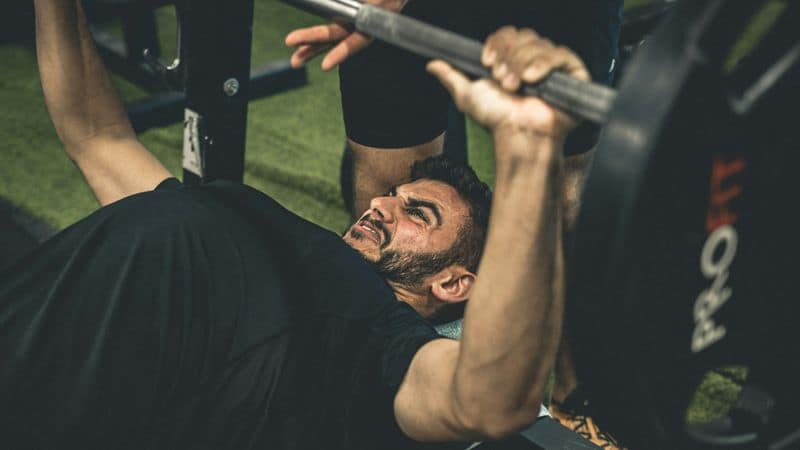
Shoulder Pain Physical Therapy in Tampa: How Lifters Get Back to Pressing
What the location of your shoulder pain means, the red flags, whether you need an MRI, and the plan that gets you benching and pressing again.
The Shoulder in Hyrox
Surviving wall balls, burpees, and ski erg – how to build a shoulder that handles hybrid volume.
Continue Reading
Tennis Elbow Physical Therapy in Tampa
Elbow pain on pull-ups, deadlifts or the pickleball court? Why rest and cortisone fall short, and the loading plan that gets your grip back.
Continue Reading
Return to Lifting After a Back Injury
A Tampa sports PT’s framework for rebuilding barbell strength after a back injury — without the endless cycle of flare-ups.
Continue Reading